 Doomsday Defense
Historical text (1922). Lye (sodium or potassium hydroxide) causes severe chemical burns and blindness. Wear eye protection and gloves, add lye to water (never water to lye), and keep it away from children.
Soap-Making Manual · 1922
Chapter VII — Standard Methods for the Sampling and Analysis of Commercial Fats and Oils (part 1 of 2)
The following report of the Committee on Analysis of Commercial Fats and Oils of the Division of Industrial Chemists and Chemical Engineers of the American Chemical Society was adopted April 14, 1919, by unanimous vote:
W. D. Richardson, Chairman, Swift and Co., Chicago, Ill.
R. W. Bailey, Stillwell and Gladding, New York City.
W. J. Gascoyne, W. J. Gascoyne and Co., Baltimore, Md.
I. Katz,[A] Wilson and Co., Chicago, Ill.
A. Lowenstein,[A] Morris and Co., Chicago, Ill.
H. J. Morrison, Proctor and Gamble Co., Ivorydale, Ohio.
J. R. Powell, Armour Soap Works, Chicago, Ill.
R. J. Quinn,[A] Midland Chemical Co., Argo, Ill.
Paul Rudnick, Armour and Co., Chicago, Ill.
L. M. Tolman, Wilson and Co., Chicago, Ill.
E. Twitchell,[A] Emery Candle Co., Cincinnati, Ohio.
J. J. Vollertsen, Morris and Co., Chicago, Ill.
[Note A: Resigned.]
Scope, Applicability and Limitations of the Methods.
SCOPE.
These methods are intended to aid in determining the commercial valuation of fats and fatty oils in their purchase and sale, based on the fundamental assumption commonly recognized in the trade, namely, that the product is true to name and is not adulterated. For methods for determining the identity of oils and fats, the absence of adulterants therein and for specific tests used in particular industries, the chemist is referred to standard works on the analysis of fats and oils.
APPLICABILITY.
The methods are applicable in commercial transactions involving fats and fatty oils used in the soap, candle and tanning industries, to edible fats and oils and to fats and fatty oils intended for lubricating and burning purposes. The methods are applicable to the raw oils used in the varnish and paint industry with the exceptions noted under limitations, but special methods have not been included.
LIMITATIONS.
The methods have not been developed with special reference to waxes (beeswax, carnauba wax, wool wax, etc.) although some of them may be found applicable to these substances. The Committee considers the Wijs method superior to the Hanus method for the determination of iodine number of linseed oil as well as other oils, although the Hanus method has been considered standard for this work for some time and has been adopted by the American Society for Testing Materials and in various specifications. It has been customary to use the Hübl method for the determination of iodine value of tung oil (China wood oil) but the Committee’s work indicates that the Wijs method is satisfactory for this determination.
Sampling.
TANK CARS.
1. Sampling While Loading—Sample shall be taken at discharge of pipe where it enters tank car dome. The total sample taken shall be not less than 50 lbs. and shall be a composite of small samples of about 1 pound each, taken at regular intervals during the entire period of loading.
The sample thus obtained is thoroughly mixed and uniform 3-lb. portions placed in air-tight 3-lb. metal containers. At least three such samples shall be put up, one for the buyer, one for the seller, and the third to be sent to a referee chemist in case of dispute. All samples are to be promptly and correctly labeled and sealed.
2. Sampling from Car on Track[23]—(a) When contents are solid.[24] In this case the sample is taken by means of a large tryer measuring about 2 in. across and about 1-1/2 times the depth of the car in length. Several tryerfuls are taken vertically and obliquely toward the ends of the car until 50 lbs. are accumulated, when the sample is softened, mixed and handled as under (1). In case the contents of the tank car have assumed a very hard condition, as in Winter weather, so that it is impossible to insert the tryer, and it becomes necessary to soften the contents of the car by means of the closed steam coil (in nearly all tank cars the closed steam coil leaks) or by means of open steam in order to draw a proper sample, suitable arrangements must be made between buyer and seller for the sampling of the car after it is sufficiently softened, due consideration being given to the possible presence of water in the material in the car as received and also to the possible addition of water during the steaming. The Committee knows of no direct method for sampling a hard-frozen tank car of tallow in a satisfactory manner.
(b) When contents are liquid. The sample taken is to be a 50-lb. composite made up of numerous small samples taken from the top, bottom and intermediate points by means of a bottle or metal container with removable stopper or top. This device attached to a suitable pole is lowered to the various desired depths, when the stopper or top is removed and the container allowed to fill. The 50-lb. sample thus obtained is handled as under (1).
In place of the device described above, any sampler capable of taking a sample from the top, bottom, and center, or from a section through car, may be used.
(c) When contents are in semi-solid condition, or when stearine has separated from liquid portions. In this case, a combination of (a) and (b) may be used or by agreement of the parties the whole may be melted and procedure (b) followed.
BARRELS, TIERCES, CASKS, DRUMS, AND OTHER PACKAGES.
All packages shall be sampled, unless by special agreement the parties arrange to sample a lesser number; but in any case not less than 10 per cent of the total number shall be sampled. The total sample taken shall be at least 20 lbs. in weight for each 100 barrels, or equivalent.
1. Barrels, Tierces and Casks—(a) When contents are solid. The small samples shall be taken by a tryer through the bunghole or through a special hole bored in the head or side for the purpose, with a 1-in. or larger auger. Care should be taken to avoid and eliminate all borings and chips from the sample. The tryer is inserted in such a way as to reach the head of the barrel, tierce, or cask. The large sample is softened, mixed and handled according to tank cars (1).
(b) When contents are liquid. In this case use is made of a glass tube with constricted lower end. This is inserted slowly and allowed to fill with the liquid, when the upper end is closed and the tube withdrawn, the contents being allowed to drain into the sample container. After the entire sample is taken it is thoroughly mixed and handled according to tank cars (1).
(c) When contents are semi-solid. In this case the tryer or a glass tube with larger outlet is used, depending on the degree of fluidity.
(d) Very hard materials, such as natural and artificial stearines. By preference the barrels are stripped and samples obtained by breaking up contents of at least 10 per cent of the packages. This procedure is to be followed also in the case of cakes shipped in sacks. When shipped in the form of small pieces in sacks they can be sampled by grab sampling and quartering. In all cases the final procedure is as outlined under tank cars (1).
2. Drums—Samples are to be taken as under (1), use being made of the bunghole. The tryer or tube should be sufficiently long to reach to the ends of the drum.
3. Other Packages—Tubs, pails and other small packages not mentioned above are to be sampled by tryer or tube (depending on fluidity) as outlined above, the tryer or tube being inserted diagonally whenever possible.
4. Mixed Lots and Packages—When lots of tallow or other fats are received in packages of various shapes and sizes, and especially wherein the fat itself is of variable composition, such must be left to the judgment of the sampler. If variable, the contents of each package should be mixed as thoroughly as possible and the amount of the individual samples taken made proportional to the sizes of the packages.
Analysis.
SAMPLE.
The sample must be representative and at least three pounds in weight and taken in accordance with the standard methods for the sampling of commercial fats and oils. It must be kept in an air-tight container, in a dark, cool place.
Soften the sample if necessary by means of a gentle heat, taking care not to melt it. When sufficiently softened, mix the sample thoroughly by means of a mechanical egg beater or other equally effective mechanical mixer.
MOISTURE AND VOLATILE MATTER.
Apparatus: Vacuum Oven—The Committee Standard Oven.
Description—The Standard F. A. C. Vacuum Oven has been designed with the idea of affording a simple and compact vacuum oven which will give as uniform temperatures as possible on the shelf. As the figure shows, it consists of an iron casting of rectangular sections with hinged front door made tight by means of a gasket and which can be lowered on opening the oven so as to form a shelf on which samples may be rested. The oven contains but one shelf which is heated from above as well as below by means of resistance coils. Several thermometer holes are provided in order to ascertain definitely the temperature at different points on the shelf. In a vacuum oven where the heating is done almost entirely by radiation it is difficult to maintain uniform temperatures at all points, but the F. A. C. oven accomplishes this rather better than most vacuum ovens. Larger ovens containing more than one shelf have been tried by the Committee, but have been found to be lacking in temperature uniformity and means of control. The entire oven is supported by means of a 4-in. standard pipe which screws into the base of the oven and which in turn is supported by being screwed into a blind flange of suitable diameter which rests on the floor or work table.
Moisture Dish—A shallow, glass dish, lipped, beaker form, approximately 6 to 7 cm. diameter and 4 cm. deep, shall be standard.
Determination—Weigh out 5 grams (= 0.2 g. of the prepared sample) into a moisture dish. Dry to constant weight in vacuo at a uniform temperature, not less than 15° C. nor more than 20° C. above the boiling point of water at the working pressure, which must not exceed 100 mm. of mercury.[25] Constant weight is attained when successive dryings for 1-hr. periods show an additional loss of not more that 0.05 per cent. Report loss in weight as moisture and volatile matter.[26]
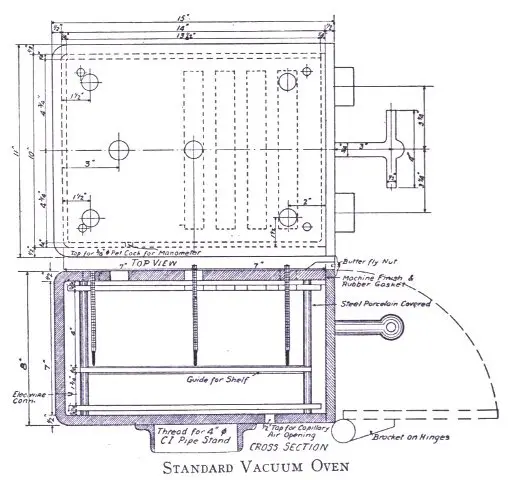
Standard Vacuum Oven
The vacuum-oven method cannot be considered accurate in the case of fats of the coconut oil group containing free acid and the Committee recommends that it be used only for oils of this group when they contain less than 1 per cent free acid. In the case of oils of this group containing more than 1 per cent free acid, recourse should be had temporarily to the routine control method for moisture and volatile matter[27] until the Committee develops a more satisfactory method.
The air-oven method cannot be considered even approximately accurate in the case of the drying and semi-drying oils and those of the coconut oil group. Therefore, in the case of such oils as cottonseed oil, maize oil (corn oil), soy bean oil, linseed oil, coconut oil, palm kernel oil, etc., the vacuum-oven method should always be used, except in the case of fats of the coconut group containing more than 1 per cent free acid, as noted above.
INSOLUBLE IMPURITIES.
Dissolve the residue from the moisture and volatile matter determination by heating it on a steam bath with 50 cc. of kerosene. Filter the solution through a Gooch crucible properly prepared with asbestos,[28] wash the insoluble matter five times with 10-cc. portions of hot kerosene, and finally wash the residual kerosene out thoroughly with petroleum ether. Dry the crucible and contents to constant weight, as in the determination of moisture and volatile matter and report results as insoluble impurities.
SOLUBLE MINERAL MATTER.
Place the combined kerosene filtrate and kerosene washings from the insoluble impurities determination in a platinum dish. Place in this an ashless filter paper folded in the form of a cone, apex up. Light the apex of the cone, whereupon the bulk of the kerosene burns quietly. Ash the residue in a muffle, to constant weight, taking care that the decomposition of alkaline earth carbonates is complete, and report the result as soluble mineral matter.[29] When the percentage of soluble mineral matter amounts to more than 0.1 per cent, multiply the percentage by 10 and add this amount to the percentage of free fatty acids as determined.[30]
FREE FATTY ACIDS.
The alcohol[31] used shall be approximately 95 per cent ethyl alcohol, freshly distilled from sodium hydroxide, which with phenolphthalein gives a definite and distinct end-point.
Determination—Weigh 1 to 15 g. of the prepared sample into an Erlenmeyer flask, using the smaller quantity in the case of dark-colored, high acid fats. Add 50 to 100 cc. hot, neutral alcohol, and titrate with N/2, N/4 or N/10 sodium hydroxide depending on the fatty acid content, using phenolphthalein as indicator. Calculate to oleic acid, except that in the case of palm oil the results may also be expressed in terms of palmitic acid, clearly indicating the two methods of calculation in the report. In the case of coconut and palm kernel oils, calculate to and report in terms of lauric acid in addition to oleic acid, clearly indicating the two methods of calculation in the report. In the case of fats or greases containing more than 0.1 per cent of soluble mineral matter, add to the percentages of free fatty acids as determined 10 times the percentage of bases in the soluble mineral matter as determined.[30] This addition gives the equivalent of fatty acids combined with the soluble mineral matter.
TITER.
Standard Thermometer—The thermometer is graduated at zero and in tenth degrees from 10° C. to 65° C., with one auxiliary reservoir at the upper end and another between the zero mark and the 10° mark. The cavity in the capillary tube between the zero mark and the 10° mark is at least 1 cm. below the 10° mark, the 10° mark is about 3 or 4 cm. above the bulb, the length of the thermometer being about 37 cm. over all. The thermometer has been annealed for 75 hrs. at 450° C. and the bulb is of Jena normal 16’‘’ glass, or its equivalent, moderately thin, so that the thermometer will be quick-acting. The bulb is about 3 cm. long and 6 mm. in diameter. The stem of the thermometer is 6 mm. in diameter and made of the best thermometer tubing, with scale etched on the stem, the graduation is clear-cut and distinct, but quite fine. The thermometer must be certified by the U. S. Bureau of Standards.
Glycerol Caustic Solution—Dissolve 250 g. potassium hydroxide in 1900 cc. dynamite glycerin with the aid of heat.
Determination—Heat 75 cc. of the glycerol-caustic solution to 150° C. and add 50 g. of the melted fat. Stir the mixture well and continue heating until the melt is homogeneous, at no time allowing the temperature to exceed 150° C. Allow to cool somewhat and carefully add 50 cc. 30 per cent sulfuric acid. Now add hot water and heat until the fatty acids separate out perfectly clear. Draw off the acid water and wash the fatty acids with hot water until free from mineral acid, then filter and heat to 130° C. as rapidly as possible while stirring. Transfer the fatty acids, when cooled somewhat, to a 1-in. by 4-in. titer tube, placed in a 16-oz. salt-mouth bottle of clear glass, fitted with a cork that is perforated so as to hold the tube rigidly when in position. Suspend the titer thermometer so that it can be used as a stirrer and stir the fatty acids slowly (about 100 revolutions per minute) until the mercury remains stationary for 30 seconds. Allow the thermometer to hang quietly with the bulb in the center of the tube and report the highest point to which the mercury rises as the titer of the fatty acids. The titer should be made at about 20° C. for all fats having a titer above 30° C. and at 10° C. below the titer for all other fats. Any convenient means may be used for obtaining a temperature of 10° below the titer of the various fats. The committee recommends first of all a chill room for this purpose; second, an artificially chilled small chamber with glass window; third, immersion of the salt-mouth bottle in water or other liquid of the desired temperature.
UNSAPONIFIABLE MATTER.
Extraction Cylinder—The cylinder shall be glass-stoppered, graduated at 40 cc., 80 cc. and 130 cc., and of the following dimensions: diameter about 1-3/8 in., height about 12 in.
Petroleum Ether—Redistilled petroleum ether, boiling under 75° C., shall be used. A blank must be made by evaporating 250 cc. with about 0.25 g. of stearine or other hard fat (previously brought to constant weight by heating) and drying as in the actual determination. The blank must not exceed a few milligrams.
Determination—Weigh 5 g. (±0.20 g.) of the prepared sample into a 200-cc. Erlenmeyer flask, add 30 cc. of redistilled 95 per cent (approximately) ethyl alcohol and 5 cc. of 50 per cent aqueous potassium hydroxide, and boil the mixture for one hour under a reflux condenser. Transfer to the extraction cylinder and wash to the 40-cc. mark with redistilled 95 per cent ethyl alcohol. Complete the transfer, first with warm, then with cold water, till the total volume amounts to 80 cc. Cool the cylinder and contents to room temperature and add 50 cc. of petroleum ether. Shake vigorously for one minute and allow to settle until both layers are clear, when the volume of the upper layer should be about 40 cc. Draw off the petroleum ether layer as closely as possible by means of a slender glass siphon into a separatory funnel of 500 cc. capacity. Repeat extraction at least four more times, using 50 cc. of petroleum ether each time. More extractions than five are necessary where the unsaponifiable matter runs high, say over 5 per cent, and also in some cases where it is lower than 5 per cent, but is extracted with difficulty. Wash the combined extracts in a separatory funnel three times with 25-cc. portions of 10 per cent alcohol, shaking vigorously each time. Transfer the petroleum ether extract to a wide-mouth tared flask or beaker, and evaporate the petroleum ether on a steam bath in an air current. Dry as in the method for moisture and volatile matter. Any blank must be deducted from the weight before calculating unsaponifiable matter. Test the final residue for solubility in 50 cc. petroleum ether at room temperature. Filter and wash free from the insoluble residue, if any, evaporate and dry in the same manner as before. The Committee wishes to emphasize the necessity of thorough and vigorous shaking in order to secure accurate results. The two phases must be brought into the most intimate contact possible, otherwise low and disagreeing results may be obtained.
IODINE NUMBER—WIJS METHOD.
Preparation of Reagents—Wijs Iodine Solution—Dissolve 13.0 g. of resublimed iodine in one liter of C. P. glacial acetic acid and pass in washed and dried chlorine gas until the original thiosulfate titration of the solution is not quite doubled. The solution is then preserved in amber glass-stoppered bottles, sealed with paraffin until ready for use.
Mark the date on which the solution is prepared on the bottle or bottles and do not use Wijs solution which is more than 30 days old.
There should be no more than a slight excess of iodine, and no excess of chlorine. When the solution is made from iodine and chlorine, this point can be ascertained by not quite doubling the titration.[32]
The glacial acetic acid used for preparation of the Wijs solution should be of 99.0 to 99.5 per cent strength. In case of glacial acetic acids of somewhat lower strength, the Committee recommends freezing and centrifuging or draining as a means of purification.
N/10 Sodium Thiosulfate Solution—Dissolve 24.8 g. of C. P. sodium thiosulfate in recently boiled distilled water and dilute with the same to one liter at the temperature at which the titrations are to be made.
Starch Paste—Boil 1 g. of starch in 200 cc. of distilled water for 10 min. and cool to room temperature.
An improved starch solution may be prepared by autoclaving 2 g. of starch and 6 g. of boric acid dissolved in 200 cc. water at 15 lbs. pressure for 15 min. This solution has good keeping qualities.
Potassium Iodide Solution—Dissolve 150 g. of potassium iodide in water and make up to one liter.
N/10 Potassium Bichromate—Dissolve 4.903 g. of C. P. potassium bichromate in water and make the volume up to one liter at the temperature at which titrations are to be made.
The Committee calls attention to the fact that occasionally potassium bichromate is found containing sodium bichromate, although this is of rare occurrence. If the analyst suspects that he is dealing with an impure potassium bichromate, the purity can be ascertained by titration against re-sublimed iodine. However, this is unnecessary in the great majority of cases.
Standardization of the Sodium Thiosulfate Solution—Place 40 cc. of the potassium bichromate solution, to which has been added 10 cc. of the solution of potassium iodide, in a glass-stoppered flask. Add to this 5 cc. of strong hydro-chloric acid. Dilute with 100 cc. of water, and allow the N/10 sodium thiosulfate to flow slowly into the flask until the yellow color of the liquid has almost disappeared. Add a few drops of the starch paste, and with constant shaking continue to add the N/10 sodium thiosulfate solution until the blue color just disappears.
Determination—Weigh accurately from 0.10 to 0.50 g. (depending on the iodine number) of the melted and filtered sample into a clean, dry, 16-oz. glass-stoppered bottle containing 15-20 cc. of carbon tetrachloride or chloroform. Add 25 cc. of iodine solution from a pipette, allowing to drain for a definite time. The excess of iodine should be from 50 per cent to 60 per cent of the amount added, that is, from 100 per cent to 150 per cent of the amount absorbed. Moisten the stopper with a 15 per cent potassium iodide solution to prevent loss of iodine or chlorine but guard against an amount sufficient to run down inside the bottle. Let the bottle stand in a dark place for 1/2 hr. at a uniform temperature. At the end of that time add 20 cc. of 15 per cent potassium iodide solution and 100 cc. of distilled water. Titrate the iodine with N/10 sodium thiosulfate solution which is added gradually, with constant shaking, until the yellow color of the solution has almost disappeared. Add a few drops of starch paste and continue titration until the blue color has entirely disappeared. Toward the end of the reaction stopper the bottle and shake violently so that any iodine remaining in solution in the tetrachloride or chloroform may be taken up by the potassium iodide solution. Conduct two determinations on blanks which must be run in the same manner as the sample except that no fat is used in the blanks. Slight variations in temperature quite appreciably affect the titer of the iodine solution, as acetic acid has a high coefficient of expansion. It is, therefore, essential that the blanks and determinations on the sample be made at the same time. The number of cc. of standard thiosulfate solution required by the blank, less the amount used in the determination, gives the thiosulfate equivalent of the iodine absorbed by the amount of sample used in the determination. Calculate to centigrams of iodine absorbed by 1 g. of sample (= per cent iodine absorbed).
Determination, Tung Oil—Tung oil shows an erratic behavior with most iodine reagents and this is particularly noticeable in the case of the Hanus reagent which is entirely unsuitable for determining the iodine number of this oil since extremely high and irregular results are obtained. The Hübl solution shows a progressive absorption up to 24 hrs. and probably for a longer time but the period required is entirely too long for a chemical determination. The Wijs solution gives good results if the following precautions are observed:
Weigh out 0.15 ± 0.05 g., use an excess of 55 ± 3 per cent Wijs solution. Conduct the absorption at a temperature of 20-25° C. for 1 hr. In other respects follow the instructions detailed above.
SAPONIFICATION NUMBER (KOETTSTORFER NUMBER).
Preparation of Reagents. N/2 Hydrochloric Acid—Carefully standardized.
Alcoholic Potassium Hydroxide Solution—Dissolve 40 g. of pure potassium hydroxide in one liter of 95 per cent redistilled alcohol (by volume). The alcohol should be redistilled from potassium hydroxide over which it has been standing for some time, or with which it has been boiled for some time, using a reflux condenser. The solution must be clear and the potassium hydroxide free from carbonates.
Determination—Weigh accurate about 5 g. of the filtered sample into a 250 to 300 cc. Erlenmeyer flask. Pipette 50 cc. of the alcoholic potassium hydroxide solution into the flask, allowing the pipette to drain for a definite time. Connect the flask with an air condenser and boil until the fat is completely saponified (about 30 minutes). Cool and titrate with the N/2 hydrochloric acid, using phenolphthalein as an indicator. Calculate the Koettstorfer number (mg. of potassium hydroxide required to saponify 1 g. of fat). Conduct 2 or 3 blank determinations, using the same pipette and draining for the same length of time as above.
MELTING POINT.
Apparatus—Capillary tubes made from 5 mm. inside diameter thin-walled glass tubing drawn out to 1 mm. inside diameter. Length of capillary part of tubes to be about 5 cm. Length of tube over all 8 cm.
Standard thermometer graduated in tenths of a degree.
600 cc. beaker.
Determination—The sample should be clear when melted and entirely free from moisture, or incorrect results will be obtained.
Melt and thoroughly mix the sample. Dip three of the capillary tubes above described in the oil so that the fat in the tube stands about 1 cm. in height. Now fuse the capillary end carefully by means of a small blast flame and allow to cool. These tubes are placed in a refrigerator over night at a temperature of from 40 to 50° F. They are then fastened by means of a rubber band or other suitable means to the bulb of a thermometer graduated in tenths of a degree. The thermometer is suspended in a beaker of water (which is agitated by air or other suitable means) so that the bottom of the bulb of the thermometer is immersed to a depth of about 3 cm. The temperature of the water is increased gradually at the rate of about 1° per minute.
The point at which the sample becomes opalescent is first noted and the heating continued until the contents of the tube becomes uniformly transparent. The latter temperature is reported as the melting point.
Before finally melting to a perfectly clear fluid, the sample becomes opalescent and usually appears clear at the top, bottom, and sides before becoming clear at the center. The heating is continued until the contents of the tube become uniformly clear and transparent. This temperature is reported as the melting point.[33] It is usually only a fraction of a degree above the opalescent point noted. The thermometer should be read to the nearest 1/2° C., and in addition this temperature may be reported to the nearest degree Fahrenheit if desired.
CLOUD TEST.
Precautions—(1) The oil must be perfectly dry, because the presence of moisture will produce a turbidity before the clouding point is reached.
(2) The oil must be heated to 150° C. over a free flame, immediately before making the test.
(3) There must not be too much discrepancy between the temperature of the bath and the clouding point of the oil. An oil that will cloud at the temperature of hydrant water should be tested in a bath of that temperature. An oil that will cloud in a mixture of ice and water should be tested in such a bath. An oil that will not cloud in a bath of ice and water must be tested in a bath of salt, ice, and water.
Determination—The oil is heated in a porcelain casserole over a free flame to 150° C., stirring with the thermometer. As soon as it can be done with safety, the oil is transferred to a 4 oz. oil bottle, which must be perfectly dry. One and one-half ounces of the oil are sufficient for the test. A dry centigrade thermometer is placed in the oil, and the bottle is then cooled by immersion in a suitable bath. The oil is constantly stirred with the thermometer, taking care not to remove the thermometer from the oil at any time during the test, so as to avoid stirring air bubbles into the oil. The bottle is frequently removed from the bath for a few moments. The oil must not be allowed to chill on the sides and bottom of the bottle. This is effected by constant and vigorous stirring with the thermometer. As soon as the first permanent cloud shows in the body of the oil, the temperature at which this cloud occurs is noted.
With care, results concordant to within 1/2° C. can be obtained by this method. A Fahrenheit thermometer is sometimes used because it has become customary to report results in degrees Fahrenheit.
The oil must be tested within a short time after heating to 150° C. and a re-test must always be preceded by reheating to that temperature. The cloud point should be approached as quickly as possible, yet not so fast that the oil is frozen on the sides or bottom of the bottle before the cloud test is reached.