Doomsday Defense
Historical text (1881). Trapping is tightly regulated today: seasons, licenses, trap types and target species. Some methods described here (including poisons) are illegal. Know your state's rules.
Camp Life in the Woods and the Tricks of Trapping and Trap Making · 1881
Book III — Traps for Feathered Game (part 3 of 3)
THE HOOK TRAP
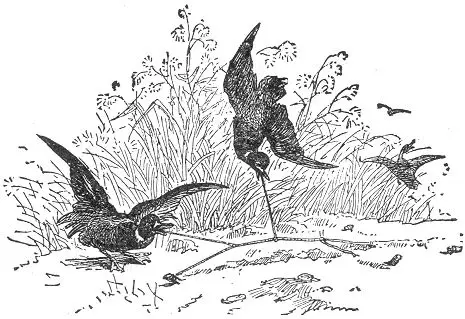
Our second example is one which we are almost tempted to exclude on account of its cruelty, but as our volume is especially devoted to traps of all kinds and as this is a variety in very common use, we feel bound to give it a passing notice. Our illustration fully conveys its painful mode of capture, and a beach at low water is generally the scene of the slaughter. A long stout cord is first stretched across the sand and secured Page 96 to a peg at each end. To this shorter lines are attached at intervals, each one being supplied with a fish hook baited with a piece of the tender rootstock of a certain water reed, of which the ducks are very fond. The main cord and lines are then imbedded in the sand, the various baits only appearing on the surface, and the success of the device is equal to its cruelty.
THE “FOOL’S CAP” TRAP.
Of all oddities of the trap kind, there is, perhaps, no one more novel and comical than the “Fool’s Cap” crow-trap, which forms the subject of our present illustration. Crows are by no means
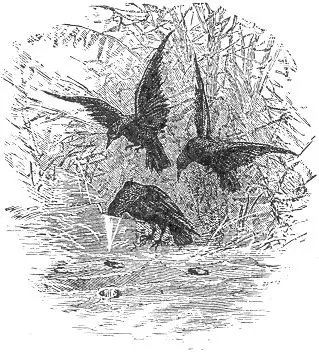
easy of capture in any form of trap, and they are generally as coy and as shrewd in their approach to a trap as they are bold in their familiarity and disrespect for the sombre scarecrows in the com field. But this simple device will often mislead the smartest and shrewdest crow, and make a perfect fool of him, for it is hard to imagine a more ridiculous sight than is furnished by the strange antics and evolutions of a crow thus embarrassed with his head imbedded in a cap which he finds impossible to remove, and which he in vain endeavors to shake off by all sorts of gymnastic performance. The secret of the little contrivance is easily told. The cap consists of a little cone of stiff paper, about three or four inches in diameter at the opening. This is imbedded in the ground, up to its edge, and a few grains of corn are dropped into it. The inside edge of the Page 97 opening is then smeared with bird-lime, a substance of which we shall speak hereafter.
The crow, on endeavoring to reach the corn, sinks his bill so deep in the cone as to bring the gummy substance in contact with the feathers of his head and neck, to which it adheres in spite of all possible efforts on the part of the bird to throw it off.
The cones may be made of a brownish-colored paper if they are to be placed in the earth, but of white paper when inserted in the snow. It is an excellent plan to insert a few of these cones in the fresh corn hills at planting season, as the crows are always on the watch at this time, and will be sure to partake of the tempting morsels, not dreaming of the result. The writer has often heard of this ingenious device, and has read of its being successfully employed in many instances, but he has never yet had an opportunity of testing it himself. He will leave it for his readers to experiment upon for themselves.
BIRD LIME.
This substance so called to which we have above alluded, and which is sold in our bird marts under that name, is a viscid, sticky preparation, closely resembling a very thick and gummy varnish. It is astonishingly “sticky,” and the slightest quantity between 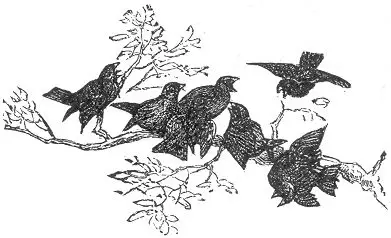 the fingers will hold them together with remarkable tenacity. What its effect must be on the feathers of a bird can easily be imagined.
This preparation is put up in boxes of different sizes, and may be had from any of the taxidermists or bird-fanciers in any of Page 98 our large towns or cities. Should a home made article be required, an excellent substitute may be prepared from the inner bark of the “slippery elm.” This should be gathered in the spring or early summer, cut into very small pieces or scraped into threads, and boiled in water sufficient to cover them until the pieces are soft and easily mashed. By this time the water will be pretty much boiled down, and the whole mass should then be poured into a mortar and beaten up, adding at the same time a few grains of wheat. When done, the paste thus made may be put into an earthen vessel and kept. When required to be used, it should be melted or softened over the fire, adding goose grease or linseed oil, instead of water. When of the proper consistency it may be spread upon sticks or twigs prepared for it, and which should afterwards be placed in the locality selected for the capture of the birds.
An excellent bird-lime may be made also from plain linseed-oil, by boiling it down until it becomes thick and gummy. Thick varnish either plain or mixed with oil, but always free from alcohol, also answers the purpose very well. The limed twigs may be either set in trees or placed on poles and stuck in the ground.
If any of our readers chance to become possessed of an owl, they may look forward to grand success with their limed twigs. It is a well known fact in natural history that the owl is the universal enemy of nearly all our smaller birds. And when, as often happens, a swarm of various birds are seen flying frantically from limb to limb, seeming to centre on a particular tree, and filling the air with their loud chirping, it may be safely concluded that some sleepy owl has been surprised in his day-dozing, and is being severely pecked and punished for his nightly depredations.
Profiting from this fact, the bird catcher often utilizes the owl with great success. Fastening the bird in the crotch of some tree, he adjusts the limed twigs on an sides, even covering the neighboring branches with the gummy substance. No sooner is the owl spied by one bird than the cry is set up, and a score of foes are soon at hand, ready for battle. One by one they alight on the beguiling twigs, and one by one find themselves held fast. The more they flutter the more powerless they become, and the more securely are they held. In this way many valuable and rare birds are often captured.
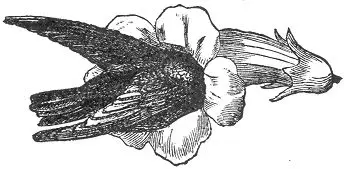
Page 99 THE HUMMING BIRD TRAP.
One of the most ingenious uses to which bird lime is said to have been applied with success, is in the capture of humming-birds. The lime in this instance is made simply by chewing a few grains of wheat in the mouth until a gum is formed. It is said that by spreading this on the inside opening of the long white lily or trumpet-creeper blossom, the capture of a humming-bird is almost certain, and he will never be able to leave the flower after once fairly having entered the opening. There can be no doubt but that this is perfectly practicable, and we recommend it to our readers.
The object in making the bird-lime from wheat consists in the fact that this is more easily removed from the feathers than the other kinds.
We would not wish our readers to infer from this that a humming-bird might be captured or kept alive, for of all birds, they are the most fragile and delicate, and would die of fright, if from nothing else. They are chiefly used for ornamental purposes, and may be caught in a variety of ways. A few silk nooses hung about the flowers where the birds are seen to frequent, will sometimes succeed in ensnaring their tiny forms.
The blow-gun is often used with good success, and the concussion from a gun loaded simply with powder, and aimed in the direction of the bird, will often stun it so that it will fall to the ground. If a strong stream of water be forced upon the little creature, as it is fluttering from flower to flower, the result is the same, as the feathers become so wet that it cannot fly.
Page 101