 Doomsday Defense
Historical text (1881). Trapping is tightly regulated today: seasons, licenses, trap types and target species. Some methods described here (including poisons) are illegal. Know your state's rules.
Camp Life in the Woods and the Tricks of Trapping and Trap Making · 1881
Book VI — Steel Traps and the Art of Trapping (part 4 of 6)
Page 186 THE OTTER.
The fur of this animal is of such exquisite softness and beauty as to be in great demand for commercial purposes, bringing a very high price in the fur market.
The otter cannot be said to be a common animal, although it is found throughout the United States and Canada, being rather more plentiful in the cold northern localities than in the southern latitudes. It is an amphibious animal, and can remain for a long time beneath the water. In size it is larger than a cat, and it possesses a tapering tail some eighteen inches in length. Its fur is of a rich brown color, and the hair is of two kinds, the one a close, fine, and exquisitely soft down, which lies next the skin, 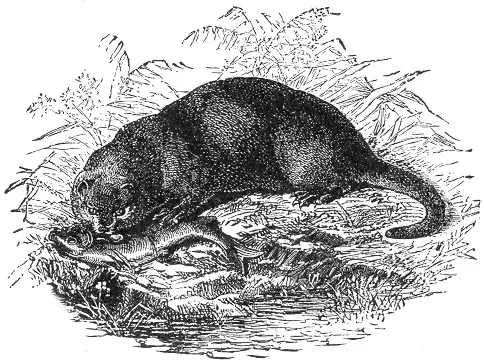 and which serves to protect the animal from the extremes of heat and cold, and the other composed of long shining coarser hairs, which permit the animal to glide easily through the water. In producing the beautiful otter furs of fashion these long hairs are plucked out, leaving only the softer down next the hide. The food of the otter mostly consists of fish, for the pursuit of which he has been admirably endowed by nature. His body is lithe and supple, and his feet are furnished with a broad web, which connects the toes, and is of infinite service Page 187 in propelling the animal through the water when in search of his finny prey. His long, broad and flat tail serves as a most effectual rudder, and the joints of his powerful legs are so flexible as to permit of their being turned in almost any direction.
The habitation of the otter is made in the banks of the river which it frequents, or sometimes in a hollow log or crevice beneath rocks. The animal generally prefers to adopt and occupy a natural hollow or deserted excavation, rather than to dig a burrow for itself. The nest is composed of dry rushes, grasses and sticks, and the young, three or four in number, are produced in early spring.
The track which the otter makes in the mud or snow is easily distinguished from that of any other animal, on account of the “seal” or impression which is made by a certain ball on the sole of the foot. Otter hunting is a favorite sport in England, and indeed in the northern parts of our own country. Hounds are used to pursue the animal, and on account of the powerfully scented secretion with which the creature is furnished by nature, its track is readily followed. When attacked, the otter is a fierce and terrible fighter, biting and snapping with most deadly energy and never yielding as long as life remains in the body. The bite of an angry otter is extremely severe, and for this reason we would caution the amateur trapper on handling the animal should one be taken alive.
Although so fierce and savage when attacked, the otter is easily tamed when taken young, and can be taught to catch fish for the service of its master, rather than for the gratification of its own palate.
In the winter when the snow is on the ground, the otter navigates by sliding, and when on the ice he may often be seen to run a few steps and then throw himself on his belly and slide the distance of several feet. They are very fond of playing in the snow, and make most glorious use of any steep snow-covered bank, sloping toward the river. Ascending to the top of such an incline they throw themselves on the slippery surface and thus slide swiftly into the water. This pastime is often continued for hours, and is taken advantage of in trapping the playful creatures. A short search will reveal the place where they crawl from the water on to the bank, and at this spot, which will generally be shallow, a steel trap should be set on the bed of the river, about four inches under water. The trap should be secured by a stout chain, the latter being ringed to a sliding pole, page 145, which will lead the animal when caught into deep Page 188 water. If deep water is not near at hand, the spring pole, page 144, may be used, the object of either being to prevent the animal from gnawing off its leg and thus making its escape.
The trap may also be placed at the top or the slide, two or three feet back of the slope, a place being hollowed out to receive it and the whole covered with snow. To make success more certain a log may be laid on each side of the trap, thus forming an avenue in which the animal will be sure to run before throwing itself on the slope. Care should be taken to handle nothing with the bare hands, as the otter is very keen scented and shy. Anoint the trap with a few drops of fish oil or otter musk, see page 151. If none of these are handy, ordinary musk will answer very well.
The trap may also be set and weighted with a heavy stone and chain, as described for trapping the beaver. Another method still is to find some log in the stream having one end projecting above water. Sprinkle some musk on this projecting end and set the trap on the log in three or four inches of water, securing it firmly by a chain, also beneath the water.
A rock which projects over the stream may also be utilized in the same way as seen in the page title at the opening of this section. Smear the musk on the edge which juts into the water, and secure the trap by the chain as before. When the animal is caught he will fall or jump into the water, and the weight of the trap and chain will sink him. In every case it is necessary to obliterate every sign of human presence by throwing water over every foot print, and over everything with which the naked hands have come in contact. Where the traps are thus set in the water it should be done while wading or in a boat. In the winter when the ponds and rivers are frozen over the otters make holes through the ice at which they come up to devour their prey. Where the water is a foot deep beneath any of these holes the trap may be set in the bottom, the chain being secured to a heavy stone. When the otter endeavors to emerge from the hole he will press his foot on the trap and will thus be caught. If the water is deep beneath the hole the trap may be baited with a small fish attached to the pan, and then carefully lowered with its chain and stone to the bottom. For this purpose the Newhouse, No. 3, is best adapted, as the otter is in this case caught by the head.
The beaten track of the animal may often be discovered in the snow in the winter time, and a trap carefully sunk in such a furrow and covered so as to resemble its surroundings, will be likely to secure the first otter that endeavors to pass over it. A trap set at the mouth of the otter’s burrow and carefully covered Page 189 is also often successful, using the sliding pole, page 145, to lead him into deep water.
Every trapper has his pet theories and methods of trapping all the different animals, and the otter has its full share. We have given several of the best methods; and anyone of them will secure the desired result of capture, and all of them have stood the test of time and experience.
The skin of the otter should be removed whole, and the operation may be performed in the following manner: Slit down the hind legs to the vent; cut the skin loose around the vent, and slit up the entire length of the tail, freeing it from the bone. With the aid of the knife the skin should now be peeled off, drawing it backward and carefully cutting around the mouth and eyes before taking it from the head.
With the fur thus inside, the skin is ready for the stretcher as described on page 273, and the tail should be spread out and tacked around the edges.
THE MINK.
This animal, as will be seen by our illustration, has a long, slender body, something like the weasel, to which scientific family it belongs. It inhabits the greater part of North America, and is also found abundantly in Northern Europe. The color of its fur varies considerably in different individuals, the general tint being a rich, dark brown. The chin and throat are light colored, sometimes white, and this spot varies considerably in size in different individuals, sometimes extending down on the throat to a considerable distance. The total length of the animal is from thirteen to sixteen inches, its size being variable.
The fur of the mink is excellent in quality, and has for many years been one of the “fancy furs” of fashion, a good prime skin often bringing from ten to twelve dollars. The introduction of the fur seal, however, and the universal demand for this as well as otter fur, has somewhat thrown the mink into comparative shade, although extra fine skins will still command high prices.
The mink is an aquatic animal, inhabiting small rivers and streams, and living somewhat after the manner of the otter. It has a most wide range of diet, and will eat almost anything which is at all eatable. Fishes, frogs, and muskrats are his especial delight, and he will occasionally succeed in pouncing upon a snipe or wild duck, which he will greedily devour. Crawfish, Page 190 snails, and water insects of all kinds also come within the range of his diet, and he sometimes makes a stray visit to some neighboring poultry yard to satisfy the craving of his abnormal hunger. A meal off from his own offspring often answers the same purpose; and a young chicken in the egg he considers the ne plus ultra of delicacies. The voracity of this animal is its leading characteristic, and is so largely in excess of its cunning or sagacity that it will often run headlong into a naked trap. Its sense of 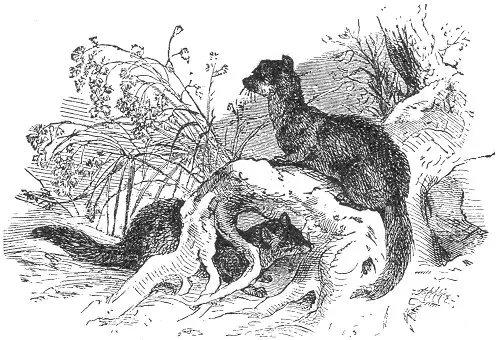 smell is exceedingly well developed, and through this faculty it is often enabled to track its prey with ease and certainty. The mink lives in burrows, in steep banks, or between rocks or the roots of trees, and the young, five or six in number, are brought forth in May.
The chief occupation of the mink consists in perpetual search for something to eat, and, when so engaged, he may be seen running along the bank of the stream, peering into every nook and corner, and literally “leaving no stone unturned” in its eager search. Taking advantage of this habit, it becomes an easy matter to trap the greedy animal. Set your trap, a Newhouse No. 2, in an inch of water near the edge of the stream, and directly in front of a steep bank or rock, on which you can place your bait. The bait may be a frog, fish, or head of a Page 191 bird, suspended about eighteen inches above the water, and should be so situated that in order to reach it, the mink will be obliged to tread upon the trap. The trap may also be set in the water and the bait suspended eighteen inches above it, by the aid of a switch planted in the mud near the trap. It is a good plan to scent the bait with an equal mixture of sweet oil and peppermint, with a little honey added. If there is deep water near, the sliding pole, page 145, should be used, and if not, the “spring pole” in every case, in order to prevent the captured mink from becoming a prey to larger animals, and also to guard against his escape by amputation, which he would otherwise most certainly accomplish.
The trap may be set on the land, near the water’s edge, baiting as just described, and lightly covered with leaves or dirt. Any arrangement of the trap whereby the animal is obliged to tread upon it in order to secure the bait, will be found effectual.
The trap may be set at the foot of a tree, and the bait fastened to the trunk, eighteen inches above it. A pen, such as is described on page 144, may be constructed, and the trap and bait arranged as there directed. Minks have their regular beaten paths, and often visit certain hollow logs in their runways. In these logs they leave unmistakable signs of their presence, and a trap set in such a place is sure of success.
Some trappers set a number of traps along the stream at intervals of several rods, connecting them by a trail, see page 153, the mink being thus led directly and almost certainly to his destruction. This trail is made by smearing a piece of wood with the “medicine” described at page 153, and dragging it on the line of the traps. Any mink which crosses this trail will follow it to the first trap, when he will, in all probability, be captured. A dead muskrat, crow, fish, or a piece of fresh meat dragged along the line answers the same purpose. The beaten tracks of the mink may often be discovered, and a trap set in such a track and covered with leaves, dirt or the like, will often be successful.
Minks may also be easily caught in the dead-fall. Garrote trap or a twitch-up, baiting with fish, muskrat, flesh, or the head of a bird, of which the animal is especially fond. A liberal use of the “medicine” is also desirable.
The fur of the mink is in its best condition in the late autumn, winter, and early spring, and the animal should be skinned as described for the fox.
Page 192 THE PINE MARTEN.
This animal belongs to the tribe of “weasels,” and is closely allied to the celebrated sable, which it greatly resembles. The pine marten is so called because it inhabits the northern climates where pine forests abound, and spends much of its life in the trees in search of its prey. Its general appearance is truly represented in our illustration, its fur being of a rich brown color, with a lighter or white patch on the throat. Its total length, including the tail, is about twenty-eight or thirty inches, of which the tail represents ten inches. It is mostly confined to the forests in the far north, 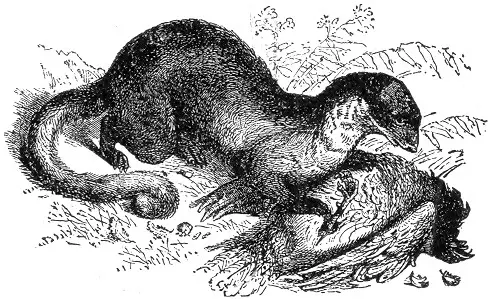 and is comparatively rare further south than the latitude of Maine and the lakes. The fur of the pine marten is of considerable value, particularly if the animal be killed in the winter. A really fine skin is but little inferior to the celebrated sable, and is hardly distinguishable from it. The hair is long and glossy, and the under fur is beautifully soft and very thick. The dark colored skins are the most valuable. Although so nearly like the sable, the same comparison does not exist in regard to their proportionate market values, the marten fur bringing a much lower price.
The marten is a shy and wary animal, withdrawing itself as far as possible from the sight of man, and building its habitation in the tops of trees, often seizing on the ready nest of some squirrel or bird, and adapting it to its purposes.
Page 193 It is a night prowler, and in the dark hours it traverses the trunks and branches of the trees in search of its prey. It moves with wonderful stealth and activity, and is enabled by its rapid and silent approach to steal unnoticed on many an unfortunate bird or squirrel, seizing it in its deadly grip before the startled creature can think to escape. Coming across a bird’s nest, it makes sad havoc with the eggs or young, often adding the parent bird to his list of victims. Rabbits, partridges, and mice also fall into the marten’s “bill of fare,” and the list is often further increased by a visit to a poultry yard, when the animal murders and eats all it can and kills the rest for sport. In pouncing upon its prey, the marten invariably seizes its victim by the throat, often dispatching the luckless creature with a single bite.
The martens generally are said to be very susceptible to human influence when taken young, and are very lively in a state of domestication. They are among the most graceful of animals, and in place of the disagreeable scent which renders many of their tribe offensive, this creature possesses an odor which is quite agreeable, and for this reason is often called the sweet marten in contradistinction to the foul marten or pole cat of Britain, which is like unto our skunk in the disgusting stench which it exhales.
The dead-fall and Garrote traps are very successful in trapping the martin. They should be set several rods apart, in the forest or on the banks of streams, and a trail established by dragging a dead or roasted crow, entrails of a bird, or fresh meat from one trap to another, as described in relation to the mink, page 190. The twitch-up may also be used, and possesses the additional advantage of acting as a spring pole, thus holding the captured victim out of reach of larger animals, to which it might otherwise become a prey. Any of the varieties described under the title of “twitch-up” will answer the purpose, and a little experimenting will soon prove which one will be the most successful for this particular animal. The bait may consist of a bird’s or fowl’s head, fish, liver, or any fresh meat or entrails.
The common box trap, page 103, or the box snare, page 56, may also be used to good purpose, but the former will need to be carefully watched lest the enclosed prisoner gnaw his way out and thus escape.
When the steel trap is employed, it should be of the size of Newhouse, No. 2-1/2, set on the ground beneath some rock, Page 194 and covered with leaves, rotten wood, or earth, and the bait fastened or suspended about eighteen inches above it, in such a position that the animal will be obliged to step upon the trap in order to reach it. An enclosure may be constructed of stones piled together, the trap being set and covered in the opening and the bait secured at the back. A staked pen, such as is described on page 143, with the trap and bait arranged as there directed, also works well. Wherever or however the trap is set, the bait should be so placed that the animal cannot possibly climb on any neighboring object to reach it. The hollow of a tree trunk forms an excellent situation for the trap, and the same hollow may also be baited at the back and a dead-fall constructed across its opening. The box or barrel pit-fall, described on page 127, is said to be very successful in trapping the marten, always baiting it with the platform secure for a few days before setting for capture. The same methods directed for the capture of the mink are also useful in trapping the marten. The animal should be skinned as described for the fox.
THE FISHER.
This animal is classed among the martens, and is principally to be found in Canada and the Northern United States, where it is known as the black cat, or woodshock. In our natural histories it is described under the name of the pekan.
In general habits, this species resembles the other martens, but its body inclines more to the weasel shape. The fur is quite valuable, and much resembles the sable. Its color is generally of a greyish brown, the grey tint being found chiefly on the back, neck, head and shoulders, the legs, tail, and back of the neck being marked with dark brown. Like the marten, the fisher prowls by night, frequenting swampy places in quest of food.
It builds its habitation in hollow trees, and in burrows, which it excavates in the banks of rivers or streams, and its young (generally twins) are produced in early spring. The trapping season for the fisher commences at about the middle of October, and extends to the middle of May, after which time the fur decreases in value.
In trapping the fisher, the same plans may be used as for the marten and mink, as these animals much resemble each other in general habits. The steel trap arranged in an artificial or Page 195 natural enclosure, or otherwise so set as that the animal will be obliged to step on it in order to reach the bait, will be successful and the use of composition “scent bait,” described on page 153 will be found to enhance success. In every case where the steel trap is used the spring pole, page 144, should always be employed, for the reasons already described.
Dead-falls, garrotes, box-traps, twitch-ups, or pit-falls, may all be employed to good advantage. Bait with a fish or bird, or fresh meat of any kind, and connect the various traps by a trail, as described for the mink and marten.
Remove the skin as directed for the fox, and stretch as described on page 273.
THE SKUNK.
This disgusting animal has won the unenviable but deserving reputation of being the most foul-smelling creature on the face of the globe. He belongs to the weasel tribe, and all these animals are noted for certain odors which they possess, but the skunk is pre-eminent in the utter noisomeness of the horrid effluvium which it exhales.
This scent proceeds from a liquid secretion which collects in a gland beneath the insertion of the tail, and the animal has the power to eject or retain it at will.
It must have been given to the creature as a means of defence, for there seems to be no animal that can withstand the influence of its fetid stench. Dogs are trained to hunt the animal, but until they have learned from experience the right method of attacking the fetid game, and have discovered the whereabouts of the animal’s magazine of ammunition, they are of little use to the hunter, and are only too glad to plunge into some neighboring brook, or roll in some near earth, in hopes of ridding themselves of the stench which almost distracts them. The offensive propensities of the skunk are only exercised when the animal is alarmed or frightened. There are generally certain “premonitory symptoms” of attack which the creature usually exhibits, and it is well to retire from his “shooting range” as soon as they are observed.
When the animal is ready to discharge his battery, he suddenly elevates his large bushy tail, over his body, and turns his back on his enemy. The result of the discharge fills the air for a great distance around, and man and beast fly from the neighborhood of the indescribable and fetid effluvium, which fairly makes one’s nostrils ache.
Page 196 A single drop of this disgusting secretion on the clothes is enough to scent the whole garment, and it is almost impossible to rid the tainted fabric from the odor.
It is extremely acrid in quality, and if a very small quantity fall upon the eyes, it is very apt to produce permanent blindness.
Dogs, in their first experiences with the skunk, are frequently thus blinded, and there are well authenticated instances of human 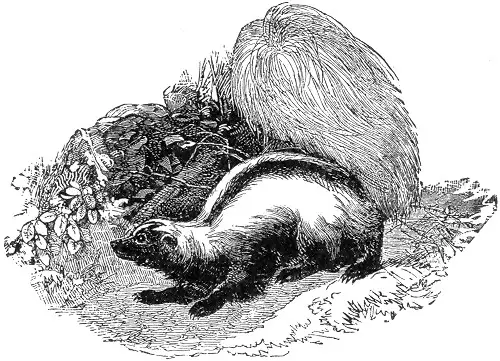 beings who have been deprived of their sight through their close proximity to an infuriated skunk.
The writer, in his extreme youth, learned, through dear experience, the putrid qualities of this noisome quadruped. It was on one bright Sunday, in New England, and he was out in his Sunday clothing, gathering wild strawberries. He suddenly discovered a pretty little playful animal with bushy tail, romping in the grass near him. The creature was seemingly gentle, and showed no inclination to run away, and the pet-loving nature of the writer prompted an irresistible desire to capture so pretty a creature. Encouraged by its gentle manner, he eagerly ran towards the tempting prize, and grasping it by the bushy tail, which the animal had raised perpendicularly, as if for a Page 197 handle, the pretty creature was locked in the affectionate embrace of its youthful admirer. But alas! he soon repented his rashness, and the treacherous “pet” was quickly flung away leaving its victim in such a foul state of overwhelming astonishment as can be more easily imagined than described.
Every article of clothing worn on that eventful Sunday had to be buried, and it took weeks of Sundays before the odor could be thoroughly eradicated from the hair and skin of the individual who wore those Sunday garments. After this adventure, the youth became more cautious with respect to pretty little playful animals, with black and white fur and bushy tails.
There is hardly a farmer in the country but what has had some amusing or serious experience with the skunk, and almost every trapper has, at one time or another, served as a target for his shooting propensities. Natural histories are replete with anecdotes of which this animal is the mephitic hero, and volumes might be filled to the glory of his strong-smelling qualities.
Perhaps it is through the prejudice of the writer that he cannot enthusiastically recommend the skunk as a domestic pet; but it is nevertheless asserted, on good authority, that these animals, when reared from the young, become very interesting and playful in the household, and completely shut down on their objectionable faculties.
Our illustration gives a very good idea of the animal, and it is so unlike any other creature that a further description will not be necessary. The prevailing colors are white and black; but these vary much in proportion, the animal sometimes being almost totally white, or altogether black. The fur is long, and comparatively coarse, being intermixed with long, glossy hairs, and is most valuable in the black animal. The body of the creature is about a foot and a half in length, exclusive of the tail, which adds about fourteen inches more.
The skunk is generally nocturnal in its habits, secreting itself during the day in hollow trees, or crevices in rocks, or wood-piles. At night it ventures forth in quest of its food, which consists chiefly of grasshoppers, worms and other insects, wild fruit and such small animals in the shape of frogs, mice and birds as it can capture. The poultry yard often offers an irresistible temptation, and both fowls and eggs often serve to appease his appetite.
The skunk is common throughout the greater part of North America, and in many localities the numbers increase very Page 198 rapidly unless checked. The young are brought forth in burrows or holes in rocks during April or May, and are from six to nine in number.
“Skunk fur” does not sound well when thought of in connection with a set of fashionable furs; and for this reason the pelt of this animal is dignified by the name of Alaska sable by all dealers in the article. When known by this fancy title it suddenly becomes a very popular addition to fashion’s winter wardrobe, and is one of the leading furs which are exported to meet the demand of foreign countries. Foul as the animal is, it seldom soils its own fur with its offensive fluid; and when carefully skinned the fur is as saleable as that of any other animal.
The Skunk is trapped in a variety of ways; and as the animal is not cunning, no great skill is required. The steel trap is most commonly used, as other wooden varieties, box traps or dead-falls, for instance, are apt to absorb and retain the stench of the animal. In using the steel trap the size No. 2 should be taken. It may be set at the entrance to their burrows or in their feeding grounds. It should be covered with loose earth or chaff, or some other light substance, and baited with small bits of meat, dead mice, or eggs placed around it. The enclosure illustrated on page 143 also answers well, and in all cases the spring pole, page 144, should be used. The dead-fall, page 107, is often employed, and the twitch-up, page 43, is a particularly effective contrivance for their capture, often preventing the evil consequences of the odor by causing instant dislocation of the neck, and this without injuring the fur. A stroke upon the backbone near the tail, by producing paralysis of the parts, also prevents the animal from using his offensive powers, and a dead-fall so constructed as to fall upon the animal at this part will accomplish the same effect. To manage this it is only necessary to place the bait far back in the enclosure, so that the skunk on reaching it will bring the rear portion of his body beneath the suspended log. The scent of the skunk is as we have said, almost ineradicable, but we would recommend chloride of lime as the most effectual antidote.
It is also said by some trappers that the odor may be dissipated by packing the garment in fresh hemlock boughs, letting it thus remain for a couple of days. This is certainly a valuable hint if true, and is well worth remembering.
For skinning the skunk, see Beaver, Otter and Fox.