 Doomsday Defense
Historical text (1881). Trapping is tightly regulated today: seasons, licenses, trap types and target species. Some methods described here (including poisons) are illegal. Know your state's rules.
Camp Life in the Woods and the Tricks of Trapping and Trap Making · 1881
Book VI — Steel Traps and the Art of Trapping (part 2 of 6)
THE WOLF.
The United States are blessed with several species of this animal. The Grey Wolf, which is the largest, and the smaller, Prairie Wolf or Coyote, being the most commonly known. There are also the White Wolf, Black Wolf and the Texan or Red Wolf. In outward form they all bear a considerable resemblance to each other, and their habits are generally similar in the different varieties.
Wolves are fierce and dangerous animals, and are very powerful of limb and fleet of foot. They are extremely cowardly in character, and will seldom attack man or animal except when by their greater numbers they would be sure of victory. Wolves are found in almost every quarter of the globe. Mountain and plain, field, jungle and prairie are alike infested with them, and they hunt in united bands, feeding upon almost any animal which by their combined attacks they can overpower.
Their inroads upon herds and sheep folds are sometimes horrifying, and a single wolf has been known to kill as many as forty sheep in a single night, seemingly from mere blood-thirsty desire.
In the early colonization of America, wolves ran wild over the country in immense numbers, and were a source of great danger; but now, owing to wide-spread civilization, they have disappeared from the more settled localities and are chiefly found in Western wilds and prairie lands.
The Grey Wolf is the largest and most formidable representative of the Dog tribe on this continent. Its general appearance is truthfully given in our drawing. Its length, exclusive of the tail, is about four feet, the length of the tail being about a foot and a half. Its color varies from yellowish grey to almost Page 159 white in the northern countries, in which latitude the animal is sometimes found of an enormous size, measuring nearly seven feet in length. The fur is coarse and shaggy about the neck and haunches, and the tail is bushy. They abound in the region east of the Rocky Mountains and northward, and travel in packs of hundreds in search of prey. Bisons, wild horses, deer and even bears fall victims to their united fierceness, and human beings, too, often fall a prey to their ferocious attacks.
The Coyote, or Common Prairie Wolf, also known as the Burrowing Wolf, as its name implies inhabits the Western plains and prairies. They are much smaller than the Grey Wolf, and not so dangerous. They travel in bands and unitedly attack whatever animal they desire 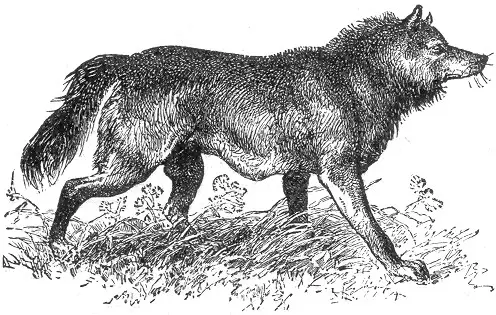 to kill. Their homes are made in burrows which they excavate in the ground. The Texan Wolf inhabits the latitude of Texas and southward. It is of a tawny red color and nearly as large as the grey species, possessing the same savage nature.
In April or May the female wolf retires to her burrow or den, and her young, from six to ten in number, are brought forth.
The wolf is almost as sly and cunning as the fox, and the same caution is required in trapping the animal. They are extremely keen scented, and the mere touch of a human hand on the trap is often enough to preclude the possibility of capture. A mere footprint, or the scent of tobacco juice, they look upon Page 160 with great suspicion, and the presence of either will often prevent success.
The same directions given in regard to trapping the fox are equally adapted for the wolf. The trap (size No, 4, page 141) should be smoked or smeared with beeswax or blood, and set in a bed of ashes or other material as therein described, covering with moss, chaff, leaves or some other light substance. The clog should be fully twice as heavy as that used for the fox. Some trappers rub the traps with “brake leaves,” sweet fern, or even skunk’s cabbage. Gloves should always be worn in handling the traps, and all tracks should be obliterated as much as if a fox were the object sought to be secured.
A common way of securing the wolf consists in setting the trap in a spring or puddle of water, throwing the dead body of some large animal in the water beyond the trap in such a position that the wolf will be obliged to tread upon the trap, in order to reach the bait. This method is described both under the head of the Fox and the Bear.
Another plan is to fasten the bait between two trees which are very close together, setting a trap on each side and carefully concealing them as already directed, and securing each to a clog of about twenty pounds in weight. The enclosure described on page 144 is also successful.
There are various scent or trail baits used in trapping the wolf. Oil of Assafœtida is by many trappers considered the best, but Oil of Rhodium, powdered fennel, fenugreek and Cummin Oil are also much used. It is well to smear a little of the first mentioned oil near the traps, using any one of the other substances, or indeed a mixture of them all, for the trail. This may be made by smearing the preparation on the sole of the boots and walking in the direction of the traps, or by dragging from one trap to another a piece of meat scented with the substance, as described under the head of Mink.
The wolf is an adept at feigning death, playing “’possum” with a skill which would do credit to that veritable animal itself.
A large dead-fall, constructed of logs, page 17, when skilfully scented and baited, will often allure a wolf into its clutches, and a very strong twitch-up, with a noose formed of heavy wire, or a strip of stout calf hide, will successfully capture the crafty creature.
In skinning the wolf the hide may be removed either by, first ripping up the belly, or in a circular piece, as described connection with the fox, both methods being much used. The Page 161 board and hoop stretchers used in preparing the skin are described on pages 273 and 275.
THE PUMA.
The puma, commonly known also as the panther or cougar, is the largest American representative of the Cat tribe, and for this reason is often dignified by the name of the “American Lion.” It is found more or less abundantly throughout the United States; and although not generally considered a dangerous foe to mankind, it has often been known in the wild districts to steal upon the traveller unawares, and in many instances human beings have fallen a prey to the powerful claws and teeth of this powerful animal.
The life of the puma is mostly in the trees. Crouching upon the branches it watches for, or steals, cat-like, upon its prey. Should a solitary animal pass within reach, the puma will not hesitate in pouncing upon the unfortunate creature; but if a herd of animals, or party of men, should be travelling together, the caution of the brute asserts itself, and he will often dog their footsteps for a great distance, in hopes of securing a straggler. Birds are struck down by a single blow of the puma’s ready paw, and so quick are his movements that even though a bird has risen on the wing, he can often make one of his wonderful bounds, and with a light, quick stroke, arrest the winged prey before it has time to soar beyond reach. The puma is a good angler. Sitting by the water’s edge he watches for his victims, and no sooner does an unfortunate fish swim within reach, than the nimble paw is outstretched, and it is swept out of the water on dry land, and eagerly devoured.
A puma has been known to follow the track of travellers for days together, only daring to show itself at rare intervals, and never endeavoring to make an attack except through stealth. The animal will often approach cautiously upon a traveller until sufficiently near to make its fatal spring; but if the pursued party suddenly turn round and face the crawling creature, the beast becomes discomfited at once, and will retreat from the gaze which seems to it a positive terror. So long as a puma can be kept in sight, no danger need be feared from the animal but it will improve every opportunity of springing unobservedly upon a heedless passer by. The total length of the puma is six feet and a half, of which the tail occupies a little over two feet. Its color is of a uniform light tawny tint, fading into light grey on Page 162 the under parts, and the tip of the tail is black. The puma is one of the few members of the Cat tribe, which are without the usual spots or stripes so observable in the tiger and leopard. The lion has the same uniformity of color, and it is perhaps partly on that account that the panther is so often known as the American lion. In infancy the young pumas possess decided tiger-like markings, and leopard-like spots, but these disappear altogether as the animal increases in size. The cougar has learned by experience a wholesome 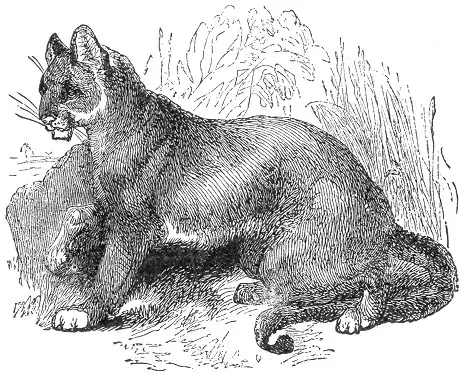 fear of man, and as civilization has extended throughout our country, the animals have been forced to retire from the neighborhood of human habitations and hide themselves in thick, uncultivated forest lands.
Sometimes, however, the animal, urged by fierce hunger, will venture on a marauding expedition for several miles, and although not an object of personal dread to the inhabitants, he often becomes a pestilent neighbor to the farmer, committing great ravages among his flocks and herds, and making sad havoc in his poultry yard. It is not the fortune of every puma, however, to reside in the neighborhood of such easy prey as pigs, sheep and poultry, and the greater number of these animals are Page 163 forced to depend for their subsistence on their own success in chasing or surprising the various animals on which they feed.
When a puma is treed by hunters, it is said to show great skill in selecting a spot wherein it shall be best concealed from the gazers below, and will even draw the neighboring branches about its body to hide itself from the aim of the hunter’s rifle. While thus lying upon the branches the beast is almost invisible from below, as its fur, when seen, harmonizes so well with the the bark which covers the boughs, that the one can scarcely be distinguished from the other.
The puma loves to hide in the branches of trees, and from this eminence to launch itself upon the doomed animal that may pass within its reach. It may, therefore, be easily imagined how treacherous a foe the creature may be when ranging at will among the countless trees and jungles of our American forests.
Although so stealthy and sly a creature the cougar possesses very little cunning and is easily trapped. The Gun trap, page 20, is commonly and successfully employed in South America in the capture of the jaguar, as our title illustration, page 15, represents, and it may also be used with the same success in trapping the puma. The Bow trap, page 23, and the dead-fall described in the early part of the book, will all be found to work admirably in the destruction of this treacherous beast.
The animal may be entrapped alive, should any of our young trappers dare to try the experiment.
There are two ways of accomplishing this. The first is by the aid of a huge coop of logs, as described on page 30 or 33, and the other by the Pit-fall, as exemplified on page 31. Huge twitch-ups may also be constructed, using very strong wire. The bait may consist of a fowl, sheep’s head, or the heart of any animal. Fresh meat of any kind will answer the purpose, and in the case of the Pit-fall a live fowl is preferable to a dead one as it will attract the puma by its motions, or by its cackling, and thus induce him to spring upon his prey, which will precipitate him to the bottom of the pit and thus effect his capture.
They are commonly taken with the steel trap. The puma seldom leaves the vicinity of the carcass of an animal it has killed until it is all devoured. When such a carcass can be found the capture of the beast is easily effected. Set the trap, size No. 5, page 143, near the remains, and cover the carcass with leaves. The next visit of the animal will find him more attached to the place than ever,—so much so that he will be unable to “tear himself away.”
Page 164 The skin of the puma is properly removed by first cutting up the belly as described under the Beaver, using great care about the head and face. Use the hoop stretcher, page 275.
THE CANADIAN LYNX.
The lynx represents another of the Cat tribe, and as its name implies is a native of the regions north of the United States, although sometimes found in upper Maine and on the lower borders of the great lakes. It is commonly known throughout Canada as the Peshoo, or “Le Chat.”
Our illustration is a truthful representation of the animal. Its total length exceeds three feet, and its tail is a mere stub. The fur is thick, and the hairs are long, the general color being grey, sprinkled with black. The legs are generally darker than the body, and the ears are often edged with white. The limbs and muscles are very powerful, the paws are very large for the size of the animal, and are furnished with strong white claws, which are imbedded in the fur of the feet when not in use, they are shown in our illustration. The ears of the lynx form a distinct feature, by which the animal could be easily identified; they are long and tipped with stiff projecting hairs, giving the creature a very odd appearance.
The peshoo can not be said to be a very dangerous animal, unless it is attacked, when it becomes a most ferocious antagonist. The writer knew of a gentleman who was pounced upon and very nearly killed by one of these infuriated creatures, and there are many like instances on record.
The principal food of the lynx consists of the smaller quadrupeds, the American hare being its favorite article of diet. It is a good swimmer, and a most agile climber, chasing its prey among the branches with great stealth and dexterity. Like the wolf, fox, and many other flesh eating-animals, the lynx does not content itself with the creatures which fall by the stroke of its own talons, or the grip of its own teeth, but will follow the trail of the puma, in its nocturnal quest after prey, and thankfully partake of the feast which remains after its predecessor has satisfied its appetite.
While running at full speed, the lynx presents a most ludicrous appearance, owing to its peculiar manner of leaping. It progresses in successive bounds, with its back slightly arched, and all the feet striking the ground nearly at the same instant. Powerful as the animal is, it is easily killed by a blow on the Page 165 back, a slight stick being a sufficient weapon wherewith to destroy the creature. For this reason the “Dead-fall” is particularly adapted for its capture, and is very successful, as the animal possesses very little cunning, and will enter an enclosure of any kind without 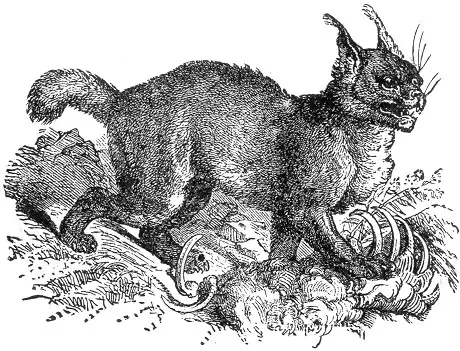 the slightest compunction, when a tempting bait is in view. The dead-fall should of course be constructed on a large scale, and it is a good plan to have the enclosure deep, and the bait as far back as will necessitate the animal being well under the suspended log in order to reach it. The bait may consist of a dead quadruped or of fresh meat of any kind.
The Gun trap, page 20, and the Bow trap, page 23, will also be found efficient, and a very powerful twitch-up, constructed from a stout pole and extra strong wire will also serve to good purpose. The lynx is not so prolific as many of the feline tribe, the number of its young seldom exceeding two, and this only once a year. The fur of the animal is valuable for the purposes to which the feline skin is generally adapted, and commands a fair price in the market. Those who hunt or trap the lynx will do well to choose the winter months for the time of their operations, as during the cold season the animal possesses a thicker and warmer fur than it offers in the summer months.
When the steel trap is used, it should be of size No. 4, page 141, Page 166 set at the opening of a pen of stakes, the bait being placed at the back of the enclosure in such a position, as that the animal will be obliged to step upon the pan of the trap in order to reach it. Any of the devices described under “Hints on Baiting” will be found successful.
The skin of the animal may be removed as directed in the case of the fox, being drawn off the body whole, or it may be removed after the manner of the beaver, and similarly stretched.
THE WILD CAT.
This animal is one of the most wide-spread species of the Cat tribe, being found not only in America, but throughout nearly the whole of Europe as well as in Northern Asia. In many parts of the United States, where the wild cat was wont to flourish, it has become exterminated, owing to civilization and the destruction of forest lands.
Many naturalists are of the opinion that the wild cat is the original progenitor of our domestic cat, but there is much difference of opinion in regard to the subject. Although they bear great resemblance to each other, there are several points of distinction between the two; one of the most decided differences being in the comparative length of the tails. The tail of the wild cat is little more than half the length of that of the domestic cat, and much more bushy.
The color of the wild animal is much more uniform than in the great raft of “domestic” mongrel specimens which make night hideous with their discordant yowls, although we sometimes see a high bred individual which, if his tail was cut off at half its length, might easily pass as an example of the wild variety.
The ground tint of the fur in the wild cat is yellowish grey, diversified with dark streaks over the body and limbs, much after the appearance of the so-called “tiger cat.” A row of dark streaks and spots extends along the spine, and the tail is thick, short and bushy, tipped with black and encircled with a number of rings of a dark hue. In some individuals the markings are less distinct, and they are sometimes altogether wanting, but in the typical wild cat they are quite prominent. The fur is rather long and thick, particularly so during the winter season, and always in the colder northern regions.
The amount of havoc which these creatures often occasion is surprising, and their nocturnal inroads, in poultry yards and Page 167 sheep folds, render them most hated pests to farmers in the countries where these animals abound. They seem to have a special appetite for the heads of fowls, and will often decapitate a half dozen in a single night, leaving the bodies in otherwise good condition to tell the story of their midnight murders. The home of the wild cat is made in some cleft of rock, or in the hollow of some aged tree, from which the creature issues in the dark hours and starts upon its marauding excursions. Its family numbers from three to six, and the female parent is smaller than the male, the total length of the latter being three feet.
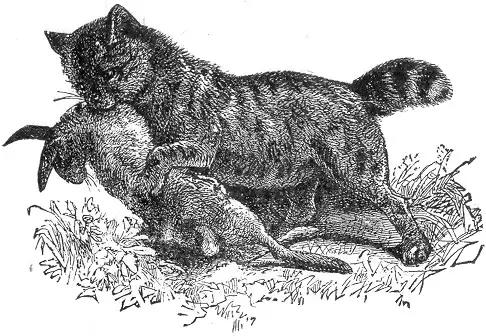
Inhabiting the most lonely and inaccessible ranges of rock and mountain, the wild cat is seldom seen during the daytime. At night, like its domestic relative, he prowls far and wide, walking with the same stealthy step and hunting his game in the same tiger-like manner. He is by no means a difficult animal to trap, being easily deceived and taking a bait without any hesitation. The wild cat haunts the shores of lakes and rivers, and it is here that the traps may be set for them. Having caught and killed one of the colony, the rest of them can be easily taken if the body of the dead victim be left near their hunting ground and surrounded with the traps carefully set and concealed beneath leaves moss or the like. Every wild cat Page 168 that is in the neighborhood will be certain to visit the body, and if the traps are rightly arranged many will be caught. The trap No. 3, page 141 is generally used. We would caution the young trapper in his approach to an entrapped wild cat, as the strength and ferocity of this animal under such circumstances, or when otherwise “hard pressed,” is perfectly amazing. When caught in a trap they spring with terrible fury at any one who approaches them, not waiting to be assailed, and when cornered or hemmed in by a hunter they will often turn upon their pursuer, and springing at his face will attack him with most consummate fury, often inflicting serious and sometimes fatal wounds. When hunted and attacked by dogs, the wild cat is a most desperate and untiring fighter, and extremely difficult to kill, for which reason it has been truthfully said that “if a tame cat has nine lives, a wild cat must have a dozen.”
The twitch-up, erected on a large scale, is utilized to a considerable extent in England in the capture of these animals; and these, together with steel traps and dead-falls, are about the only machines used for their capture. We would suggest the garrote, bow and gun trap also as being very effective. The bait may consist of the head of a fowl or a piece of rabbit or fowl flesh: or, indeed, flesh of almost any kind will answer, particularly of the bird kind.
In skinning the wild cat the same directions given under the head of the Fox may be followed, or the pelt may be ripped up the belly and spread on a hoop stretcher, page 275.
THE BEAR.
There are several species of the Bear tribe which inhabit our continent, the most prominent of which are the Grizzly, and the Musquaw or common Black Bear. There is no other animal of this country which is more widely and deservedly dreaded than the grizzly bear. There are other creatures, the puma and wild cat, for instance, which are dangerous when cornered or wounded, but they are not given to open and deliberate attack upon human beings. The grizzly, however, or “Ephraim,” as he is commonly termed by trappers, often displays a most unpleasant readiness to attack and pursue a man, even in the face of fire arms. In many localities, however, where hunting has been pursued to considerable extent, these animals have learned from experience a wholesome fear of man, and are not so ready to assume the offensive, but a “wounded” grizzly is one of the Page 169 most horrible antagonists of which it is possible to conceive, rushing upon its victim with terrible fury, and dealing most tearing and heavy blows with its huge claws.
In length this formidable animal often exceeds eight feet, and its color varies from yellowish to brownish black, and some specimens are found of a dirty grey color.
The legs are usually darker than the rest of the body, and the face is generally of a lighter tint. The fore limbs of the animal are immensely powerful; and the foot of a full-grown individual is fully eighteen inches long, and armed with claws five inches in length. The grizzly inhabits the Rocky Mountain regions and northward, being found in considerable numbers in the western part of British America. Its hair is thick and coarse, except in the young animal, which possesses a beautiful fur.
All other creatures seem to stand in fear of this formidable beast. Even the huge bison, or buffalo, of the Western Prairies sometimes falls a victim to the grizzly bear, and the very imprint of a bear’s foot upon the soil is a warning which not even a hungry wolf will disregard.
Its food consists of whatever animal it can seize, whether human or otherwise. He also devours green corn, nuts, and fruits of all kinds. In his earlier years he is a good climber, and will ascend a tree with an agility which is surprisingly inconsistent with the unwieldy proportions of his body.
The average weight of a full-grown grizzly is over eight hundred pounds, and the girth around the body is about eight feet.
The Black bear, or Musquaw, which we illustrate is common throughout nearly all the half settled-districts of North America. But as the fur and fat are articles of great commercial value, the hunters and trappers have exercised their craft with such skill and determination that the animals are gradually decreasing in numbers. The total length of the black bear is seldom more than six feet, and its fur is smooth and glossy in appearance. The color of the animal is rightly conveyed by its name, the cheeks only partaking of a reddish fawn color.
It possesses little of that fierceness which characterizes the grizzly, being naturally a very quiet and retiring creature, keeping itself aloof from mankind, and never venturing near his habitations except when excited by the pangs of fierce hunger. When pursued or cornered it becomes a dangerous antagonist; and its furious rage often results in fearful catastrophes to both man and beast. Nothing but a rifle ball in the right spot will Page 170 check the creature, when wrought up to this pitch of fury, and an additional wound only serves to increase its terrible ferocity. Bear-chasing is an extremely dangerous sport; and there are few bear-hunters in the land, however skilful, but what can show scars from the claws or teeth of some exasperated bruin.
The food of the black bear is mostly of a vegetable character, 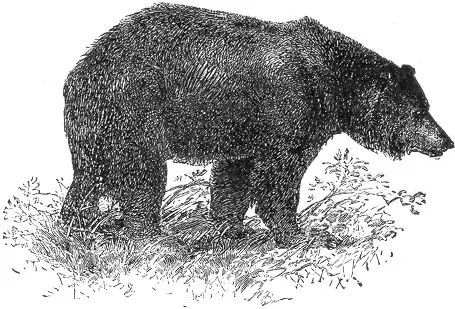 animal diet not being indulged in unless pressed by hunger. At such times it seems to especially prefer a young pig as the most desirable delicacy; and even full-grown hogs, it is said, are sometimes lifted from their pens and carried off in his deadly embrace.
Honey is his especial delight; and he will climb trees with great agility in order to reach a nest of bees, there being few obstacles which his ready claws and teeth will not remove where that dainty is in view. He is also very fond of acorns, berries, and fruits of all kinds.
The young of the bear are produced in January or February, and are from one to four in number. They are very small and covered with grey hair, which coat they retain until they are one year of age. The flesh of the bear is held in high esteem among hunters, and when properly prepared is greatly esteemed by epicures.
The fat of the animal is much used under the title of “Bear Page 171 grease,” and is believed to be an infallible hair rejuvenator, and therefore becomes a valuable article of commerce.
The bear generally hibernates during the winter, choosing some comfortable residence which it has prepared in the course of the summer, or perhaps betaking itself to the hollow of some tree. Sometimes, in case of early snow, the track of the bears may be distinguished, and if followed will probably lead to their dens, in which they can be secured with logs until it is desired to kill them.
The black bear has a habit of treading in a beaten track, which is easily detected by the eye of an experienced hunter or trapper, and turned to good account in trapping the animal.
There are various modes of accomplishing this result. The bear Dead-fall, described on page 17, is, perhaps, the most commonly used, and the Pit-fall, page 31, and “Giant Coop” trap are also excellent. The Gun trap and stone dead-fall, page 20, we also confidently recommend. When a steel trap is used it requires the largest size, especially made for the purpose. It should be supplied with a short and very strong chain firmly secured to a very heavy clog or grappling-iron page 147. If secured to a tree or other stationary object, the captured animal is likely to gnaw or tear his foot away, if, indeed, he does not break the trap altogether by the quick tightening of the chain. The clog should be only heavy enough to be an impediment, and may consist of a log or heavy stone. The grappling-iron, however, is more often used in connection with the bear trap. It is a common method in trapping the bear to construct a pen of upright branches, laying the trap at its opening, and covering it with leaves. The bait is then placed at the back in such a position that the animal, on reaching for it, will be sure to put his foot in the trap.
An experienced trapper soon discovers natural openings between rocks or trees, which may be easily modified, and by the addition of a few logs so improved upon as to answer his purpose as well as a more elaborate enclosure, with much less trouble. Any arrangement whereby the bear will be obliged to tread upon the trap in order to secure the bait, is, of course, all that is required. The bait may be hung on the edge of a rock five feet from the ground, and the trap set on a smaller rock beneath it. He will thus be almost sure to rest his forefoot on the latter rock in order to reach the bait, and will thus be captured.
Another way is to set the trap in a spring of water or swampy Page 172 spot. Lay a lump of moss over the pan, suspending the bait beyond the trap. The moss will offer a natural foot-rest, and the offending paw will be secured.
Bears possess but little cunning, and will enter any nook or corner without the slightest compunction when in quest of food. They are especially fond of sweets, and, as we have said, are strongly attracted by honey, being able to scent it from a great distance. On this account it is always used, when possible, by trappers in connection with other baits. These may consist of a fowl, fruit, or flesh of any kind, and the honey should be smeared over it. Skunk cabbage is said to be an excellent bait for the bear; and in all cases a free use of the Oil of Anise page 152, sprinkling it about the traps, is also advisable. Should the device fail, it is well to make a trail (see page 153) in several directions from the trap, and extending for several rods. A piece of wood, wet with Oil of Anise, will answer for the purpose.
The general method of skinning the bear consists in first cutting from the front of the lower jaw down the belly to the vent, after which the hide may be easily removed. The hoop-stretcher page 275, will then come into good use in the drying and preparing of the skin for market.