 Doomsday Defense
Camp Fires and Camp Cooking · 1862
Camp Cooking and Camp Kettles
The utensils and means furnished by government to the soldier for preparing his food are of the most primitive character. The former consist of camp kettles, made of iron, with a handle, and varying in size from four to seven gallons, (they should be made so as to have one slide into the other, in nests of four,) and mess pans, also of iron, about 12 inches in diameter, and sloping to the bottom. The latter consist of a certain amount of wood per diem, which is to be consumed as taste or ingenuity may dictate. The usual and most simple mode is to dig a trench 18 inches wide, 12 inches deep, and from four to six feet long. At each end plant a forked stick of equal height, with a stout sapling, from which to suspend the kettles, extending from one to the other.
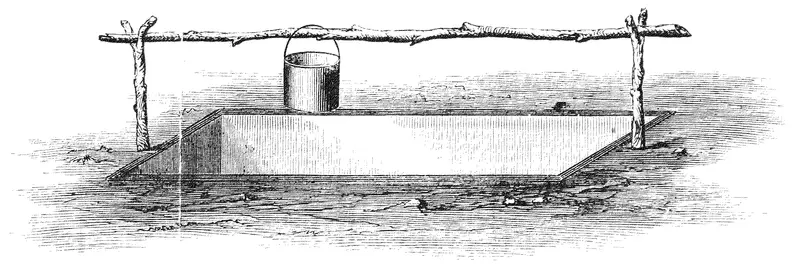
Diagram No. 1.
This, however, is neither the best nor most economical mode, as it consumes much fuel, wastes much of the heat, and causes great inconvenience to the cook. An improvement can be effected by casing the sides of the trench with brick, adding a little chimney at one end, and, in place of the forked sticks, using iron uprights and cross-bar, to which half a dozen hooks for hanging kettles are attached.
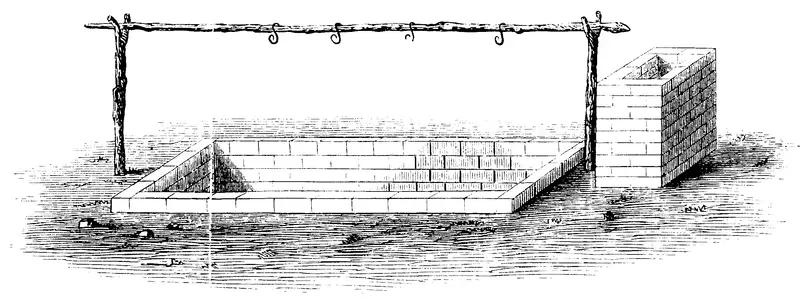
Diagram No 2.
In a clayey soil, the plan adopted by the salt boilers of New York is perhaps the neatest, most economical, and most convenient that can be devised. They dig a hole about three feet square and two feet in depth, generally in the slope of a hill. On one side they run a shaft laterally, about one foot square and six feet in length, and one foot from the surface of the ground. At the extreme end they sink a shaft vertically, and form a chimney; and at equi-distances they pierce three holes of sufficient diameter to prevent the kettles from slipping through. By this mode the kettles can be placed over the fire to boil—or on either side, to simmer—with less difficulty than by any other means.
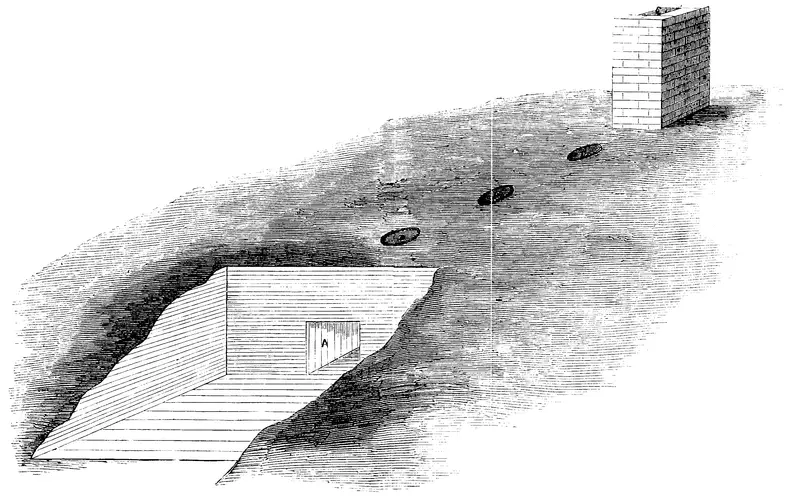
Diagram No 3.
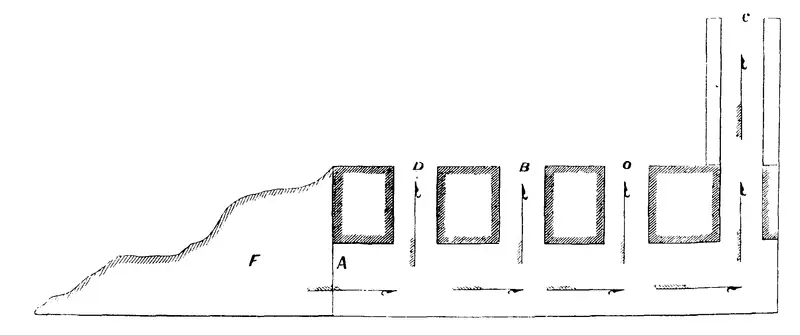
Diagram No 4.
Inside view—Side.
Besides the allowance from government, however, the company cooks should be furnished, from the “Company Fund,” with two large iron spoons, two large iron forks, two stout knives, one tin cullender and one yard of flannel; also a false tin bottom, closely fitting the kettles; for all of which the cook should be responsible.
The Ration
No army in the world is so well provided for, in the shape of food, either as to quantity or quality, as the army of the United States, and very little attention on the part of the cook will enable him to lay up a liberal amount weekly to the credit of the Company Fund. No one man can consume his daily ration, although many waste it; and a systematic issue will, in a great measure, prevent unnecessary extravagance.
The Cook’s Creed
Cleanliness is next to godliness, both in persons and kettles: be ever industrious, then, in scouring your pots. Much elbow grease, a few ashes, and a little water, are capital aids to the careful cook. Better wear out your pans with scouring than your stomachs with purging; and it is less dangerous to work your elbows than your comrade’s bowels. Dirt and grease betray the poor cook, and destroy the poor soldier; whilst health, content, and good cheer should ever reward him who does his duty and keeps his kettles clean. In military life, punctuality is not only a duty, but a necessity, and the cook should always endeavor to be exact in time. Be sparing with sugar and salt, as a deficiency can be better remedied than an overplus.
Kitchen Philosophy
Remember that beans, badly boiled, kill more than bullets; and fat is more fatal than powder. In cooking, more than in anything else in this world, always make haste slowly. One hour too much is vastly better than five minutes too little, with rare exceptions. A big fire scorches your soup, burns your face, and crisps your temper. Skim, simmer, and scour, are the true secrets of good cooking.